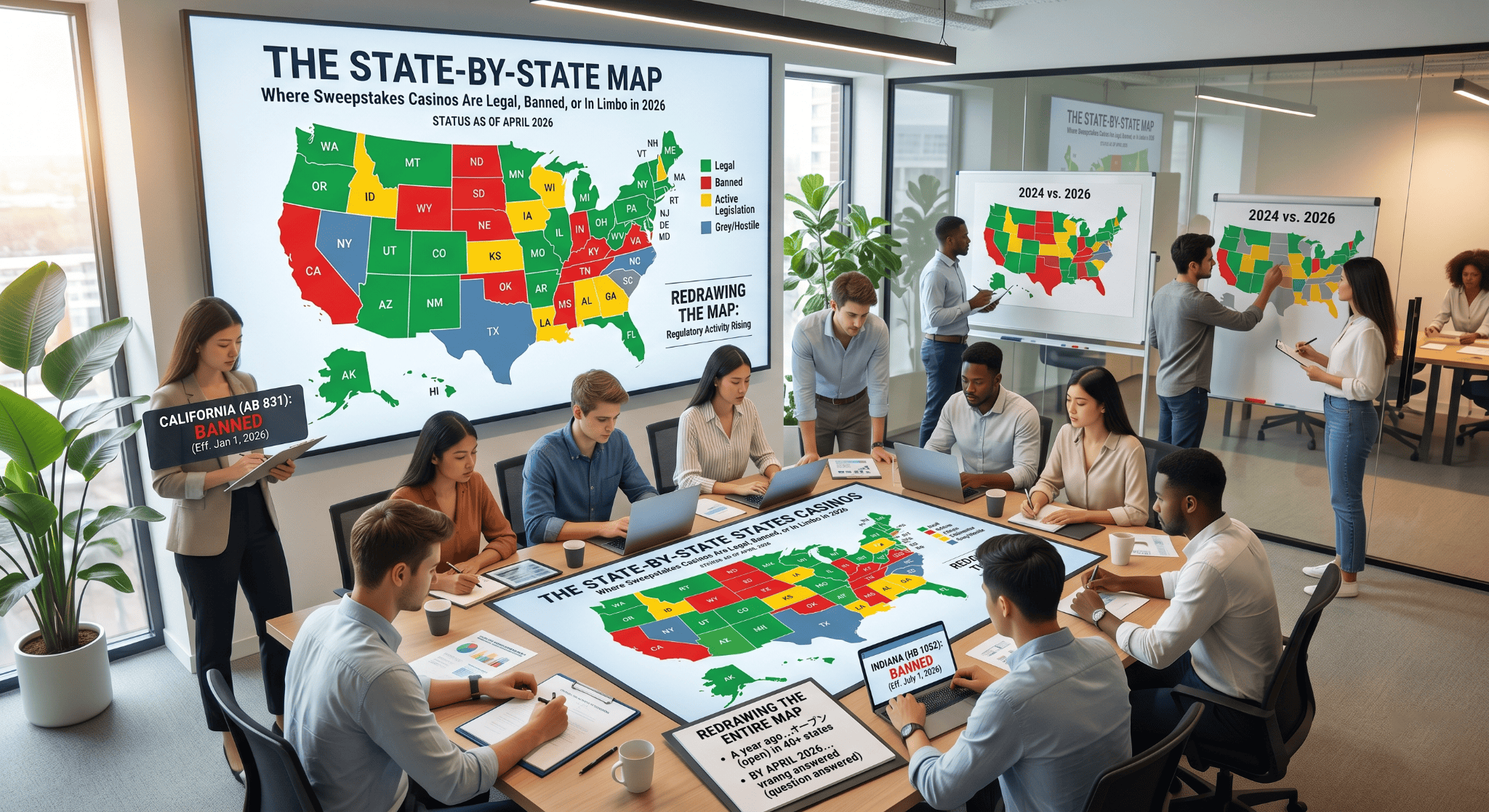
The sweepstakes casino map looked very different a year ago. At the start of 2025, the model was operating openly in more than 40 states, and the regulatory conversation was mostly about whether it counted as gambling. By April 2026, that question has been answered in enough jurisdictions to redraw the entire map — and the redrawing isn’t finished.
This is an attempt at a clean, current picture: which states have banned the dual-currency model, which are actively considering it, which are openly hostile without formal legislation, and which still permit it without restriction. The situation is moving fast enough that any piece like this has a shelf life of roughly a quarter, so dates are included throughout so readers can judge for themselves how much may have shifted since publication.
The scale is significant. Industry analysts have projected the US sweepstakes casino market at around $4 billion in annual revenue heading into 2026, and according to Yay Sweepstakes and other industry trackers, the number of active platforms serving US players now sits above 200. That scale is exactly why state legislatures have stopped treating the sector as a curiosity.
How We Got Here
Sweepstakes casinos use a two-currency system: Gold Coins, which are played for fun and have no cash value, and Sweeps Coins, which can be redeemed for cash prizes. Operators argue the model is a promotional sweepstakes, legally distinct from gambling because no purchase is required to obtain Sweeps Coins (the Alternative Method of Entry, or AMOE, is legally mandatory). Critics — including the American Gaming Association and most state tribal gaming coalitions — argue the dual-currency structure is gambling in all but name, and that the AMOE exists mainly on paper.
Through 2024 and early 2025, the industry was growing fast while regulators were slow to act. That changed abruptly in mid-2025. The backdrop matters: the broader expansion of legal US gambling over the past five years created both the political appetite and the regulatory infrastructure to act on adjacent gambling-style products. Sweepstakes casinos were next in line.
Montana and Connecticut’s bans took effect on October 1, 2025, California’s AB 831 was signed by Governor Newsom on October 11, 2025 and took effect January 1, 2026, and Indiana’s HB 1052 — the first 2026 ban — was signed by Governor Braun on March 13, 2026, with enforcement starting July 1.
States Where Sweepstakes Casinos Are Banned (as of April 2026)
These states have passed legislation explicitly prohibiting dual-currency sweepstakes platforms, or have enforcement regimes strict enough that no major operator serves them:
- California — Banned under AB 831, effective January 1, 2026. The law extends criminal liability to operators, payment processors, geolocation providers, gaming content suppliers, and media affiliates, with fines up to $25,000.
- Connecticut — Banned under SB 1235, effective October 1, 2025.
- Montana — Banned, effective October 1, 2025.
- New York — Banned under S5935 in 2025, with liability extending to supporting businesses similar to California’s model.
- New Jersey — Banned in 2025.
- Michigan — Declared illegal by the Michigan Gaming Control Board; no major operator currently serves Michigan residents.
- Washington — Functionally banned under RCW 9.46.240, which makes it a Class C felony to transmit gambling information online. Washington’s gambling law does not include a no-purchase-necessary exemption, so the AMOE defence doesn’t apply here.
- Nevada — Prohibited; all major operators block Nevada IPs.
- Louisiana — Prohibited.
- Maine — Banned under LD 2007, effective July 14, 2025.
- Idaho — Cash prize redemption prohibited, which functionally neuters the model even where play is nominally allowed.
Taking effect later in 2026:
- Indiana — HB 1052 signed March 13, 2026, takes effect July 1, 2026. Civil penalties up to $100,000 per violation.
States With Active Legislation in 2026
These states have bills moving through their legislatures as of April 2026. Each could join the banned column within months:
- Maryland — HB 295 passed the House of Delegates 105-24 and is with the Senate.
- Oklahoma — SB 1589 takes the strictest approach of any current bill, classifying violations as Class C2 felonies and extending liability to geolocation providers, platform hosts, promoters, and media affiliates.
- Minnesota — SF 4474 would ban dual-currency sweepstakes operations. Minnesota regulators have already sent cease-and-desist letters to multiple operators.
- Louisiana — HB 883 was fast-tracked through its first and second House readings in April 2026.
- Washington, D.C. — Council Bill 260656 would simultaneously legalise iGaming and ban dual-currency sweepstakes, with fines up to $500,000 for repeat violations.
- Tennessee — An earlier ban bill was amended to instead commission a study on a regulated sweepstakes market, making Tennessee one of the few states exploring regulation rather than prohibition.
- Florida, Virginia, Iowa, Mississippi — 2026 session bills failed, but the issue is expected to return.
States Where Sweepstakes Casinos Operate, But Under Pressure
These states currently allow sweepstakes casinos to operate but have shown clear regulatory hostility — cease-and-desist letters, enforcement actions, or vocal lobbying against the model:
- Arizona — Cease-and-desist letters issued to operators in 2025.
- Delaware — No explicit ban, but many operators voluntarily avoid the state.
- Pennsylvania — Regulators have flagged concerns; several major operators (notably Stake.us) do not serve Pennsylvania.
- West Virginia — Similar profile to Pennsylvania; several operators avoid the state.
- Illinois — Regulatory interest rising; no current legislation but worth watching.
- Georgia — Operating legally but named in enforcement discussions.
States Where Sweepstakes Casinos Operate Without Significant Restriction
The bulk of the country. As of April 2026, sweepstakes casinos operate without state-level legislative or enforcement pressure in approximately 30 states, including Texas, Ohio, Colorado, North Carolina, South Carolina, Missouri, Kansas, Nebraska, Wisconsin, Massachusetts, New Hampshire, Vermont, Rhode Island, and most of the Mountain West and Plains states. Age requirements vary by operator (18+ or 21+), and standard federal sweepstakes rules apply — but there’s no state-specific obstacle to play.
Operator coverage varies even within this group. Some platforms voluntarily exclude states where the regulatory signal is ambiguous, so “legal” doesn’t always mean “every operator serves you.” The practical check is whether the specific operator accepts sign-ups from your state, which is geolocation-enforced at registration.
Patterns Worth Noticing
Regulated iGaming states are the most hostile. The states with legal real-money online casinos — New Jersey, Michigan, Connecticut, Pennsylvania, West Virginia — are disproportionately represented among the banned or hostile columns. The logic is straightforward: licensed operators pay tax, sweepstakes operators don’t. International coverage shows the same pattern playing out in other jurisdictions: once a regulated market exists, unregulated adjacent products face political pressure regardless of their technical legal status.
The scope of liability is expanding. Early bans targeted operators only. More recent laws — California’s AB 831, New York’s S5935, Oklahoma’s pending SB 1589 — extend to payment processors, geolocation providers, content suppliers, and media affiliates. This matters because it makes operating in grey-area states progressively more expensive even where technically permitted: supporting companies start declining the business risk.
Regulation as an alternative is losing, for now. Several states have considered licensing frameworks for sweepstakes casinos instead of outright bans. Indiana’s HB 1052 saw a regulatory amendment proposed and rejected twice. New Jersey has a competing bill proposing licensing. None of these regulatory approaches have passed. The political momentum is overwhelmingly on the ban side. Industry analysis has increasingly framed the sweepstakes question as a test case for whether any future digital gambling-adjacent model can survive state-level scrutiny in iGaming states.
Operators are exiting proactively. Many sweepstakes operators — VGW (Chumba, LuckyLand), Stake.us, High 5, McLuck, WOW Vegas — now have a pattern of exiting states before enforcement rather than waiting for bans to take effect. That means the list of states where you can actually play is often smaller than the list of states where it’s technically legal, because individual operators have made their own risk calls.
What This Means If You Play
Three practical takeaways:
First, check your state’s current status and your chosen operator’s state list before creating an account. Both change.
Second, if you’re in a state where a ban is pending but not yet in effect (Indiana, as of this writing), redeem any Sweeps Coins balance before the effective date. California players who didn’t redeem by December 31, 2025, faced forfeiture depending on individual operator terms.
Third, don’t use a VPN to circumvent geolocation blocks. Every major operator’s terms of service voids winnings obtained this way, and in states like Washington, accessing an unauthorized gambling site can carry its own legal exposure regardless of how you got there.
Where Things Go From Here
The honest read is that the sweepstakes model is being steadily squeezed. The number of fully-permissive states has shrunk from 45+ to around 30 in less than 18 months, and the 2026 legislative session is producing bans faster than 2025 did. Whether the industry stabilizes around a smaller footprint, successfully pivots to a regulated model in some states, or continues to contract depends largely on what happens in Maryland, Oklahoma, Louisiana, and DC over the next six months. Those are the states to watch.
A piece like this will be partially wrong within a quarter. That’s not a flaw of the writing; it’s the nature of the subject. Treat the snapshot above as a starting point, and verify your specific state before you play.